I’m bringing my trio with Ted Poor and Ben Street to the Atlas in Washington DC tomorrow night (Wednesday, May 30th, 8pm). Brad Linde, who curates the jazz series at the Atlas and is also a saxophonist/bandleader of renown on the DC scene, asked me a few questions ahead of the gig. (Cross-posted from the Atlas Arts Blog).
Brad: How does your approach to improvising/accompanying/etc change based on the different contexts you encounter?
Dan: The essence of improvisation is context. That’s what’s special about it. Since it’s happening in real time, since we’re actually making music up on the spot, at its deepest level it should reflect everything about the current moment. I’m not only talking about the note choices that my bandmates make, and that I respond to; I’m also talking about subtle things like the sound of the room we’re playing in, what we’ve eaten that day, how we’ve slept, and what the weather is like outside. In improvisation, we have the opportunity to take all this into account at an intuitive level. It’s exactly like having a conversation with a group of people: depending on how noisy the room is, how well you know the people, the general vibe, you’ll participate in a unique way — if you’re really listening, that is (we all know people who seem oblivious to context, interrupting and forcing their point across). So I see the challenge of improvisation as listening to the current context in as sensitive and authentic a way as possible, and letting myself respond. The other side of this challenge is to be able to find yourself in that context: not to give in to it completely but to find the balance between it and who you are. Continue reading


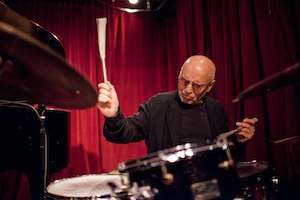 I have a really clear memory of dropping in on a trio set with Paul Bley, Gary Peacock and Paul Motian while passing through New York when I was 17 or so. It was Motian who struck me the most: on one tune — and I can see this clearly in my mind 12 years later — all he played was his ride cymbal. After the tune ended, a guy in front of me leaned in towards his date and said: “only Paul Motian could pull that off”, and that was really my first clear realization of that most mysterious element of music, the ability that great musicians have to infuse the tiniest thing — a single cymbal hit, for example — with layers of meaning. How is that even possible? It’s just a cymbal hit, after all. But Paul was staring so hard at the cymbal, and his concentration was clearly so intense, that somehow it didn’t sound like a cymbal but like some kind of personal expression, like a smile, a raised eyebrow or a laugh. Paul was one of the rare players who never sound like they’re playing notes — it goes straight past craft into expression, past “music” (in the non-transcendent sense) into “art”.